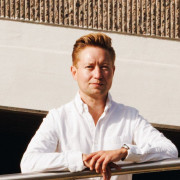

The rapid transformation of the communications environment is a vast human experiment that is putting our values and norms to the test.


One could hardly interview a professor of communication ethics and not expect the interviewee to reflect on the structure and message of the yet-unwritten interview. The newly appointed Professor of Communication Ethics Henrik Rydenfelt skilfully verbalises the reasons why studying research on communication and, in particular, communication ethics is essential at this time.
"We are in the middle of the greatest human experiment in history. Our communication environment has become thoroughly digital, so the biggest changes show first in the digital world. The most obvious example is, of course, artificial intelligence, which has been embedded in all forms of communication, despite the fact that we do not yet even understand its risks. At the same time, this is an extremely interesting time from a researcher's perspective."
Research on communication ethics can help highlight the values that guide and that should guide the new communication environment.
"Digital technologies are constantly giving rise to new questions that they cannot resolve. In particular, a deep understanding of the values and norms of communication are in high demand: in research, among students, in the field of media and communications, and more broadly in our entire society. I anticipate that this demand will only grow in the future."
Rydenfelt hopes that the theme of future will be especially prominent in this interview. The whole degree programme of communication studies at the University of Eastern Finland is founded on the idea that it is not only educating the current generation of communication professionals but also aiming to understand what skills and abilities will be needed in the future.
"Our research in the field of communication is highly future-oriented. Its findings help us build visions of the kind of communication environment we will have in the next decade."
Over the past 15 years, it has become very clear that all actors – including politicians seeking power through democratic pathways – have to adapt to the demands of large corporations and their algorithms. And the interests of companies operating in Silicon Valley are not tied to the Finnish society or its values.
Henrik Rydenfelt
Professor
What will the future communication environment be built on?
Rydenfelt has a doctorate in philosophy. He calls this new professorship tailor-made for him - and his colleagues agree. This position combines two of Rydenfelt’s research areas.
"In a way, ethics is the oldest science, but many people view it as a kind of armchair pondering. Since my doctoral dissertation, I have been developing the idea of ethics as practical or even experimental research. I was already working in media and communication studies at the University of Helsinki at that time. Since then, I have been also conducting empirical research on the changes of the communication and media environment and their ethical and societal significance."
The existing communication systems are guided by objectives that have not been democratically defined and with a value base that has not been carefully considered.
"Over the past 15 years, it has become very clear that all actors – including politicians seeking power through democratic pathways – have to adapt to the demands of large corporations and their algorithms. And the interests of companies operating in Silicon Valley are not tied to the Finnish society or its values."
A different kind of future requires new concepts and researched data. The purpose of Rydenfelt’s research is to provide them.
‘What does the communication environment of the future look like when new technology can turn any piece of content into a totally different version for everyone, often in the form of images and sound instead of text? My research team is creating visions to help us see what kind of problems come with new developments and what are the values or re-interpreted values that we should be building our future on."
Communication experts leading the way
"This decade has shown that the era of crises and conflicts is far from over. Solving the existential questions for the humankind is largely founded on communication, which is part of all decision-making. And without communication, it wouldn’t be possible to write one single line or bit of research, which is the only way to develop sustainable solutions," Rydenfelt says.
His professorship is the first appointment based on the new type of foundational funding from the University of Eastern Finland, as the professorship was established through donations from the Joensuu University Foundation and Karjalaisen kulttuurin edistämissäätiö. As a job title, “Professor of Communication Ethics” is very rare - the first of its kind in Finland - and even internationally, it is almost totally unique.
According to Rydenfelt, the field of communication ethics is often misunderstood as something that simply aims to prevent incorrect practices.
"Communication that conveys nothing or almost nothing meaningful is also ethically problematic. Politicians and sales speech can strip words of their meaning very quickly. Artificial intelligence only accelerates this process. An AI chatbot can spew out words, speech, and pictures, but it has no care for their consequences. When words stop having meaning, promises and statements will also no longer be binding. Eventually, acting responsibly becomes impossible."
It is also possible that meaningless “hogwash” could start to impair our thinking.
Rydenfelt says that this is where communication experts need to step in. In the future, they will play an increasingly important role in leading and developing meaningful communication.
"In the future, the role of values and ethical questions will be even more important in the middle of all this hogwash. For this reason, it is important that there are experts who see when words and images start to lose meaning. There isn’t a machine that could yet replace this skill."
Henrik Rydenfelt
- Professor of Communication Ethics from 1 November 2026–, University of Eastern Finland
- PhD (theoretical philosophy), University of Helsinki, 2014
- Docent of Practical Philosophy and Media and Communication Studies, University of Helsinki 2018
Key positions and achievements (and recognitions)
- Founder of the European Pragmatism Association, coordinator of the Nordic Pragmatism Network, and one of the founders of the Nordic Network for Media and Communication Ethics
- Member of the Research Council of Finland’s Centre of Excellence in Meliorist Philosophy of Suffering (MePhiS)
- Member (2020–2023) and vice-chairperson (2021–2023) of the Council for Mass Media, member of the working group updating the Guidelines for Journalists 2024
- Vice-chair (2016–2017) and Chair (2018–2019) of the Council of Ethics for Communication in Finland
- Journalist or editor in various international and Finnish scientific publications, e.g. Editor of Media & viestintä 2024–2026
- Tiedettä suomeksi award (Science in Finnish, 2022)