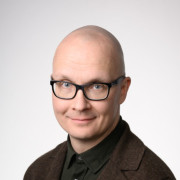

Juhana Venäläinen describes himself as a numbers-loving humanist whose research interests revolve around cultural environments.


“I share cultural studies scholar Mikko Lehtonen’s view that the ultimate mission of cultural studies is to answer questions about ‘what is going on’ and ‘how is that connected to everything else’,” says the newly appointed Professor of Cultural Studies, Juhana Venäläinen.
According to him, cultural studies is about examining the nature of the present both up close and from a distance. The discipline also looks back to the beginnings that have made the present possible, and forward to potential futures that emerge from contemporary culture.
At the University of Eastern Finland, cultural studies is strengthened by Venäläinen’s appointment to what is now the third – or, depending on the perspective, even the fourth – professorship in the field. His professorship focuses on research on cultural environments, while Professor Tuija Saresma studies, among other things, populism and hate speech, and Teo Kurki holds a professorship focused on cultural change. In addition, the university’s cultural studies landscape includes Simo Mikkonen’s professorship in sociocultural remembering.
“Cultural studies at Joensuu enjoys a well-established position in the Finnish cultural studies landscape. I hope that in my new role, I can strengthen the University of Eastern Finland’s reputation as an interdisciplinary hub for research on contemporary culture, and on the structures of culture and power,” Venäläinen says.
From the joy of ownership to the burden of overconsumption
We live in exceptional times in many respects. Various crises, ranging from wars to climate change and biodiversity loss to political tensions, are creating new kinds of order and, at the same time, demand analysis of the transformations. For a scholar of cultural studies, this challenging era is, in many ways, fertile ground for research.
Over the past decade, Venäläinen has explored two main lines of research: the study of environmental cultures, and the study of cultures of work and the economy.
“The economy is closely linked with all the changes taking place around us, and with crises as well. My research is characterised by examining cultural phenomena from both macro and micro perspectives – on the one hand as broad societal undercurrents and contemporary snapshots, on the other hand as everyday experiences that challenge and give nuance to grand narratives of change.”
One outcome of these interests is the research project Post-Ownership, led by Venäläinen and funded by Kone Foundation. Post-Ownership refers to a shift in economic discourse and thinking, where exclusive and permanent ownership is seen as burdensome and outdated. Instead, various forms of sharing and communal use appear to offer greater freedom.
“Not long ago, material possessions were used to signal wealth and status. Gradually, attitudes have shifted so that possessions have become more of a burden, something to be got rid of.”
This message is conveyed to us through both traditional and social media. Excessive possessions are said to tie us down and encourage overconsumption, while feeding the idea of an eroding sense of community caused by individualistic ownership.
“Social media portrays alternative lifestyles where people sell off all their possessions and start a new life on the road, living in a camper van. And we see homes that are stripped down to minimalist neatness, with claims of carefree living without the constant burden of stuff.”
Not long ago, material possessions were used to signal wealth and status. Gradually, attitudes have shifted so that possessions have become more of a burden, something to be got rid of.
Juhana Venäläinen
Professor of Cultural Studies

An unexpected polarisation
Ownership is thus portrayed as shaping our lives in many ways, and ideals linked to a sense of community began to gain ground in the early 2010s.
“People got excited about the rise of the sharing economy, as companies like Uber and Airbnb struck gold, transforming the taxi and hotel industries without owning a single taxi or a hotel themselves.”
Since then, discussions around the topic have taken on increasingly concerned tones, as new forms of communality have, in growing, also contributed to precarious work and distorted housing markets.
“Unexpectedly, the situation has become quite polarised. On the one hand, the sharing economy has fostered a sense of community, while also being economically efficient. On the other, dystopian interpretations have also emerged, suggesting that power concentrates in the hands of a few tech companies, leaving individuals with very little influence.”
Cultural studies contributes to solving complex problems
The Post-Ownership project has inspired not only Venäläinen’s research group but others as well, spawning new research teams and networks alongside it. According to Venäläinen, a nationwide scholarly community is forming around the cultural study of the economy, and a book is now emerging from this collaboration – with cultural studies at Joensuu playing a key role.
“Our aim in the coming years is to strengthen the University of Eastern Finland’s position as an active centre for research in cultural studies pertaining to work and economic phenomena, and environmental cultures, with strong expertise in ethnographic, textual and digital methods,” Venäläinen notes.
He emphasises that research addressing the interrelations of the economy, the environment, politics and digital transformations also broadly supports the university’s strategic goal of generating relevant knowledge to reinforce the conditions for a sustainable future and to help solve complex societal problems.
From music to an academic career
In addition to his professorship starting at the beginning of 2026, Venäläinen will also take on the role of the Head of the School of Humanities.
“This is an interesting combination. After years on the tenure track, progressing towards a professorship and convincing others of my academic career and competence, I now find myself in a role where I get to consider the success of the entire school.”
He says he is fully committed to supporting the whole school and genuinely wants to help the entire community succeed in what they do.
But there is time for leisure as well: some of Venäläinen’s free time is currently spent at the Joensuu Conservatory, built on the campus a few years ago.
“I originally trained as an ensemble and orchestral musician, with piano as my main instrument. Now I’ve gradually returned to playing again, as my children have become interested in music, too.”
However, Venäläinen has not gone back to the piano but now plays the flute as a hobby.
“It’s wonderful to have regained a strong connection to music. This gives me freedom to do something outside of work that I don’t have to be particularly good at to enjoy it.”
Juhana Venäläinen
- Professor of Cultural Studies 1 Jan 2026–
- Born in 1984, Kotka
- PhD (cultural studies), University of Eastern Finland, 2015
- MA (cultural studies, specialisation in the sociology of art), University of Eastern Finland, 2010
- Title of Docent, cultural studies of work and the economy, University of Jyväskylä, 2021
Key roles
- Assistant Professor and Associate Professor (tenure track), University of Eastern Finland, 2018–2025
- Senior Researcher in the ERC Advanced Grant project Sensory Transformations, 2018
- Principal Investigator in the project Post-ownership as an Interpretation and Experience of Economic Change, 2022–2026, funded by Kone Foundation
- Principal Investigator of the Finnish sub-project of Digital Aestheticization of Fragile Environments (DigiFREN), 2022–2025
- Recipient of the Vuoden Tiedekynä Academic Writing Award 2016 (co-awardee with Tero Toivanen); nominated for the award also in 2023
- Editor-in-Chief of the Kulttuurintutkimus journal, 2020–2022 (with Hanna Kuusela)